
everyday miracles
A Chat with Jay Mark
by Rita Selby | Photos courtesy of Jay Mark
February 1, 2026—New York City. It is a clear night outside of the Cathedral of St. John the Divine where the Oratorio Society of New York (with the author in the alto section!) has performed a program of French music in the Cathedral’s great hall for a receptive international audience. Brave souls warmed by the music on a frigid New York night. With his wife Ana enjoying their Florida home, audio engineering legend Jay Mark was in the audience and launches an impromptu bevy of (non-denominationally) spiritual insights, captured for Dialogue Matters.
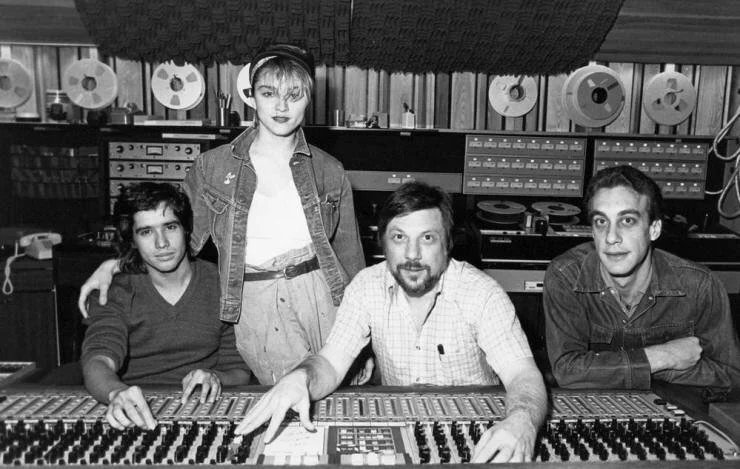
Jay (center/right) on a break recording Madonna at Sigma Sound Studios, Philadelphia.
Down-to-earth and easygoing, Jay Mark is your average super-smart and humorous guy. His matter-of-fact way of stating truisms on life and cosmology are the only giveaway: you’re talking to a true master.
Audio engineering legend
From live sound for The Beatles to audio engineering hits for Madonna, Stevie Wonder, The Talking Heads and The Allman Brothers, among countless other superstars of the 20th century, Jay has been responsible for shaping the soundtrack of our lives. On the wall, behind the man who expertly leads a group that has convened in his home, focusing on The Four Agreements™ (the simple wisdom book by Don Miguel Ruiz) hangs a Platinum album. Only one of his numerous Grammy and Emmy awards, and Platinum albums. And when not doing live mixes or music coordinating for The View or Good Morning America on ABC-TV, with quite literally the who’s who of American music—from Andrea Bocelli and John Legend to James Taylor, Mariah Carey, Tony Benett and Usher—Jay’s upper west side apartment transformed into a foundational space for New York seekers to earnestly bring the simple-but-not-easy teachings of Ruiz’ Toltec wisdom into their daily lives:
Don’t Take Anything Personally
Don’t Make Assumptions
Be Impeccable With Your Word
Always Do Your Best
— from The Four Agreements™ by Don Miguel Ruiz
RS: I like what you said about how the only control you have over something is how you feel about it.
JM: Thanks. My personal mantra is, “In life, there’s what happens, and there’s how you feel about it.” Sometimes you can influence what happens and sometimes you can’t, but you always have some choice about how you respond to it. The first reaction may be voluntary, but what happens after that is where you have a vote.
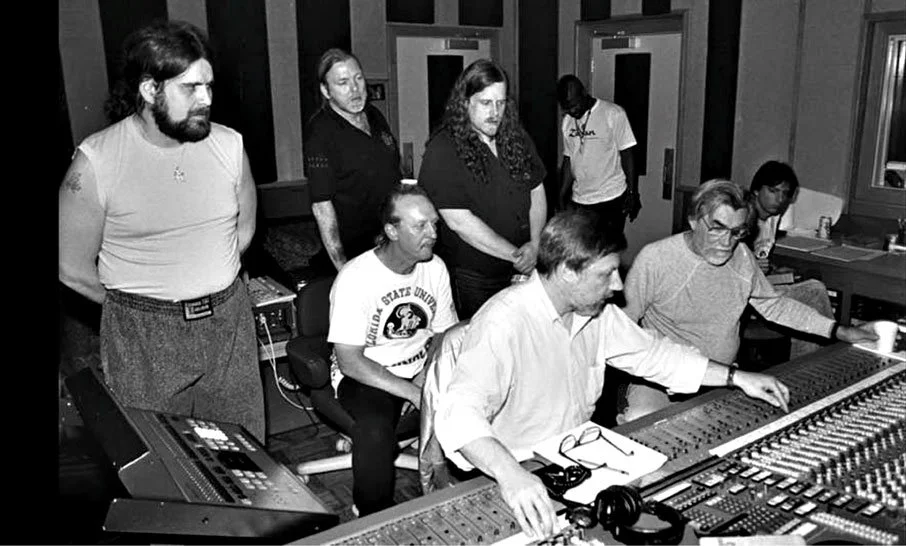
Jay at the board making The Allman Brothers sound great at Ardent Studios, Memphis, TN.
RS: How do you go about that?
JM: Practice. Practice is the only way I know to get better at it.
RS: Can you give an example?
JM: Sure. Suppose I spill spaghetti on the floor. Maybe I want to apologize to the waiter, maybe I’ve broken a dish and I’m worried I’ll have to pay for it, and maybe everybody is looking at me and I’m thinking, “What an idiot I am.” I might feel guilty or stupid even though it was an accident. In my life, I always go by intention. If I know I didn’t intend to do harm, I free myself from guilt and regret while I can still honestly express compassion and empathy. But manifesting this behavior starts with Awareness of what happened and Accepting it for what it was. Independent of my subjective judgment. (And Gratitude is in there as well, as things could always be worse.)
RS: That’s a big one.
JM: When it comes to the family situations we were talking about, the question is: What is your role in this, or what are you going to make your role? There are things you’re born into—you can’t choose your genetics or your history—but you do have some control over what goes on in your head and how you respond. Experience teaches you what works and what doesn’t. If you spent yesterday miserable because you didn’t get the job, at the end of the day you can ask yourself: Could I have done anything differently? What can I learn from the way I handled it? In theory, you can exercise a great deal of control over your mind and over what makes you feel the way you do. In practice, of course, theory and practice are two different things—but you wouldn’t be here if it wasn’t for your family.
RS: So if you spill the spaghetti, it’s up to you how you feel about it…
JM: That’s right. And then my history and my assumptions come into it. I may have learned, for example, to hear my mother’s voice in my head when I spill something. So awareness is the first step: notice what’s happening inside you before automatically acting on it. There will always be a reflex. Your history gets the first vote because it helped create that reflex. But today gets another vote. The more you learn, the more choices you have about how to handle what comes up.
[And] the more you know, the more you learn how you would handle what comes up. You can’t help that the guy just bumped into your car and smashed your fender, but you can help how you feel about it. Ultimately, it’s how you feel about anything that’s your life experience. You are how you feel. So you can have a vote on that.
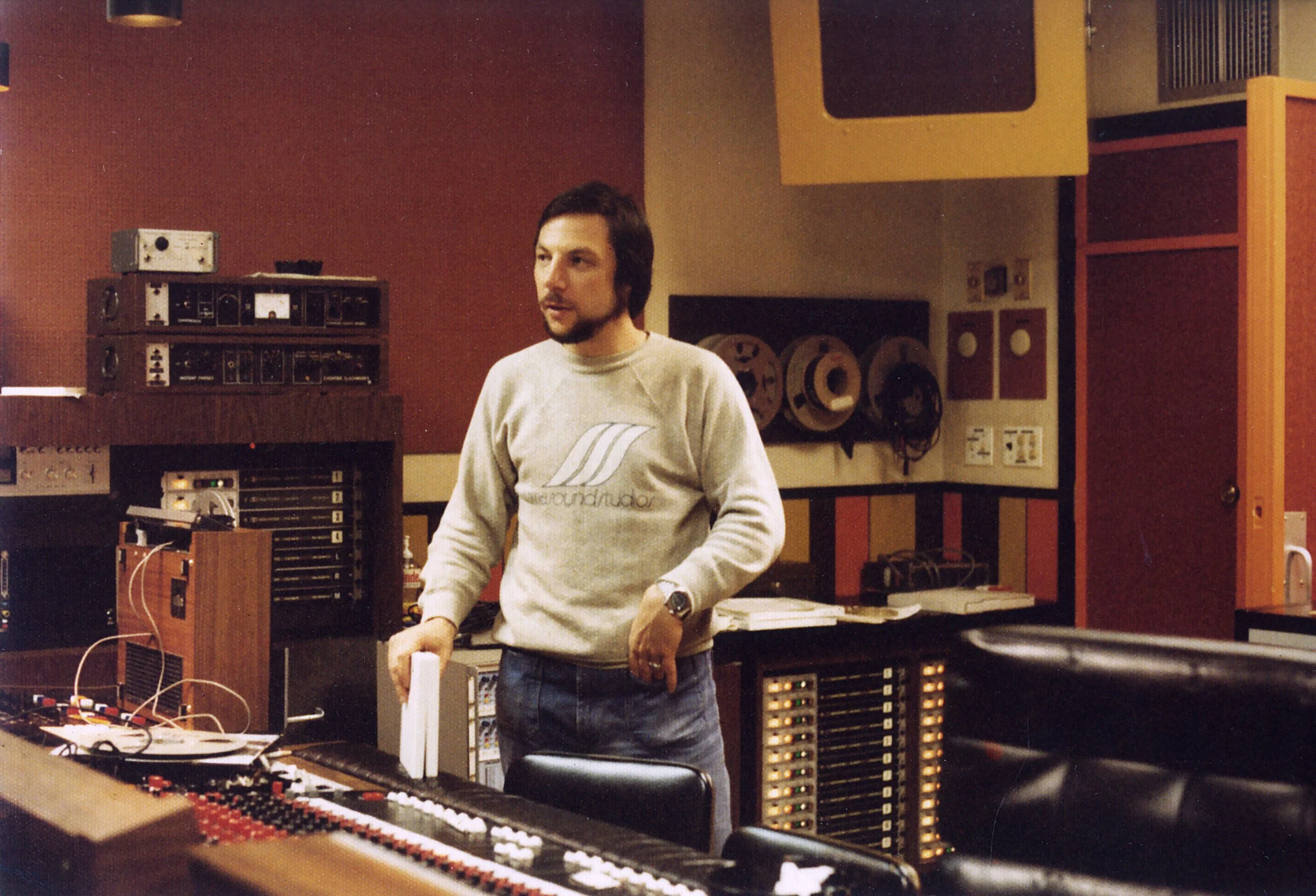
Sigma Sound Studios. Philadelphia, 1976.
GRATITUDE: like money in the bank
JM: A lot of the time, you don’t feel as though you have a choice. Your history, your genetics, your morality—all of these things influence what happens in your life. But at some point, you have to acknowledge that you have something to say about how you respond. You have a tool. For me, that might be The Four Agreements™; for someone else it might be philosophy or simply an understanding of reality. The point is that you get a say in how you feel about things. If something isn’t working, work on it.
RS: Mhm!
JM: You’re going to have bad days. For me, the shower is a kind of reset. I take a shower every day and think: “This is the best— hot water.” I’m already happy for the day. You start by appreciating things you normally take for granted. It’s like money in the bank.
RS: Gratitude!
JM: Awareness and Gratitude. Because it could be worse.
And take the spaghetti example. You may not be able to control the first feeling when you drop it. That has already happened. But everything after that is up to you. You can apologize, offer to clean it up, and decide to be more careful next time. The event is over; what you do next is where you have a choice.
common sense wisdom
JM: The first reaction is a reflex. You don’t necessarily have control over it; it’s the result of everything you’ve experienced up to that point. But what you do after the reflex is where your choice comes in. It’s not exactly a profound revelation. It’s common sense.
RS: That’s wisdom! Common sense wisdom! In other words, not reacting. Making a choice rather than acting on the reaction.
JM: Exactly. You can’t always help what happens in the moment. After the reflex, though, it’s back on you.
RS: And you were saying, when you have more awareness, it breeds some responsibility.
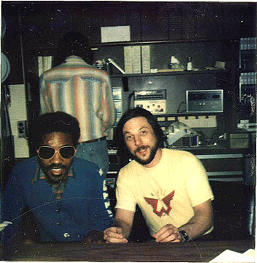
Stevie Wonder with his colleague Jay Mark, Sigma Sound Studios, Philadelphia.
JM: Yes. The direction of your life changes according to what you decide to do next. Some things are outside your control, but when something is within our control, you should try to exercise that control productively—using common sense, past experience, and an awareness of what works and what doesn’t.
There’s an old analogy about two twins who experience the same event but react very differently. The point is that the event itself doesn’t completely determine the experience; the response matters. Again, there’s a difference between theory and practice. In theory, you can think your way out of almost anything. In practice, there’s a lot of inertia, so you have to work at it.
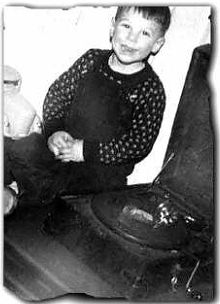
Jay’s musical ears developed early!
AWARENESS, SPACE AND TIME
JM: Some of us are better at that kind of thinking than others. We don’t even fully understand how the brain works, let alone how the universe came to be. There are enormous questions about space and time and why there is Something rather than Nothing. But you can’t solve all of that at once. You have to cut off a little slice of it and work on that.
RS: With all of these thoughts, you still do have to decide what you’re going to do with those awarenesses.
JM: You’re automatically living your life. The question is what you do with the awareness you have.
RS: So we were talking about: when you have sown your thoughts so deep into—I’m going to call it cosmic consciousness. Just how the world works, how gravity works! You speak about gravity pretty regularly. You have awareness of gravity.
JM: That’s been a constant question for me since I was a kid. And now, apparently, the explanation is: space is curved. What we experience as gravity is related to the way mass curves spacetime around it.
RS: Really!
JM: Right. When mass exists in space, it curves the space around it. Einstein’s work predicted that this curvature would affect the path of light. During a solar eclipse, the apparent position of a star near the Sun could be compared with its position when the Sun wasn’t in the way. The measurements differed because the Sun’s gravity bends spacetime and, therefore, the path of the light reaching us.
So it isn’t simply that gravity is a force pulling everything inward. In general relativity, mass changes the geometry of spacetime, and objects and light move through that curved geometry.
RS: Alters the space it’s in—
JM: Yes. A path that would otherwise be straight is no longer straight in curved spacetime. And that leads into the relationship between space and time, which are inextricably linked—and which I don’t even begin to fully understand.
RS: So we’re creative people, but we’re also people people. And there are actually more people people than there are creative people. Because one thing we all have in common is that we’re people, you know? I think we have a great opportunity with the way the world is now, that we can share as we want to. It wasn’t possible before, and now it is.
JM: You mean because of the technology?
RS: Yeah, it’s now possible to share our thoughts and our views on things, and I benefit a lot from others. I would like to contribute also and it’s awesome that you’re willing to chat about the way you see things because I think it’s very cool. [Following your founding and longtime hosting of the The Four Agreements™ Wisdom Group in NY] we’ve done some co-hosting which has been great and I have benefitted—and continue to—from the group you ran at your place back in—
JM: Yeah—2002!
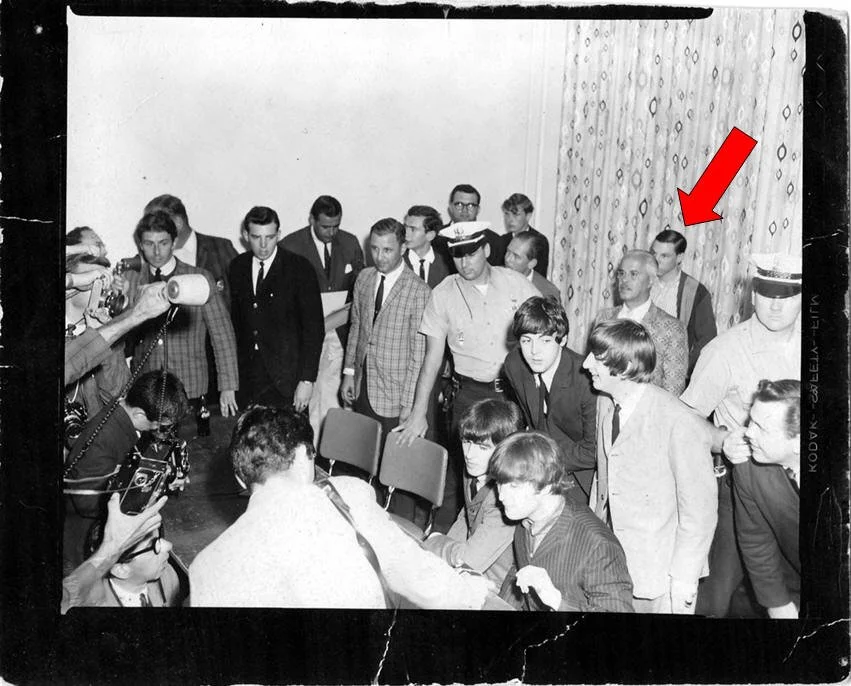
Jay Mark running live sound for The Beatles in Atlantic City, 1964.
RS: That was quite a while ago. And I believe that that kind of stuff - even though we can’t see it with our eyes - does have a life of its own and does become part of the reality we have in the present. I’m seeing what we’re doing right now, in the here-and-now, as a continuity of that time.
JM: It is a nice way to think about it: that you’re carrying a torch forward, even though we don’t have the meetings anymore.
RS: —at least not for this moment. But I think that it’s all part of what you’re saying: the agreements we make with ourselves.
JM: Yeah. It’s the same basic idea: what we agree to think about and how we agree to respond becomes part of the way we live.
RS: What we agree to think about, talk about, how we agree to feel about things—
JM: Without realizing it. That’s where awareness comes in. I’d say the more aware we are, the more responsible our actions can be.